California Teaching Pyramid
Early Elementary Professional Development
Services Designed for Teachers, Administrators, and Classified Staff Who Support Children in Transitional Kindergarten Through Second Grade
 (opens in a new tab)
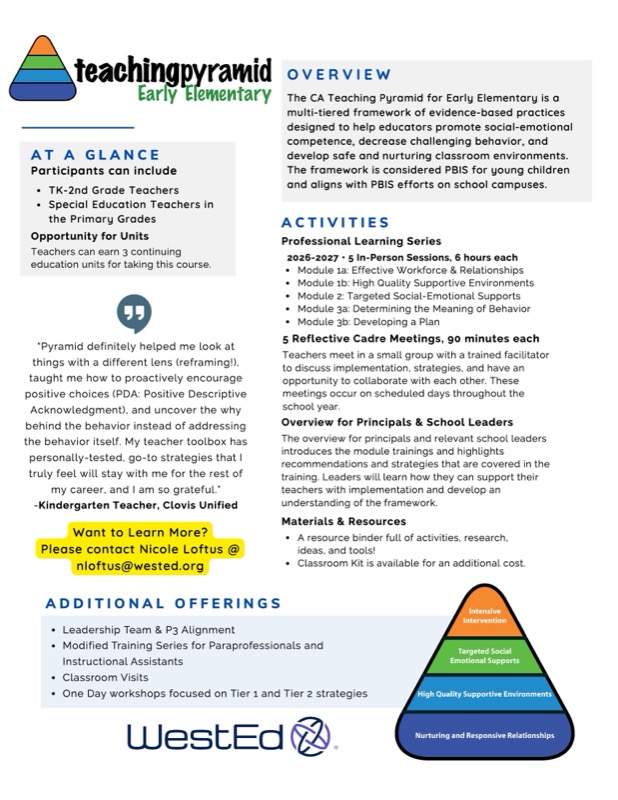
Early Elementary Flyer (PDF)
The CA Teaching Pyramid for Early Elementary is a multi-tiered framework of evidence-based practices designed to help educators promote social-emotional competence, decrease challenging behavior, and develop safe and nurturing classroom environments The framework is considered PBIS for young children and aligns with PBIS efforts on school campuses.
This Early Elementary flyer promotes activities and additional offerings for the 2026-2027 school year.
CA Teaching Pyramid Framework

The CA Teaching Pyramid is the name used to describe the framework originally developed by the Center on the Social Emotional Foundations for Early Learning (CSEFEL) and is now operated by National Center for Pyramid Model Innovations. The Center developed and disseminated the Teaching Pyramid, a systematic framework of evidence-based, user-friendly practices to help early childhood educators meet the needs of the growing number of children with behaviors adults find challenging and mental health concerns. The Teaching Pyramid approach incorporates early childhood Positive Behavior Support to promote healthy social-emotional development, support children’s appropriate behavior, prevent behavior that is challenging, and address behavior issues.
WestEd’s adaptation of this framework is named The CA TEACHING PYRAMID FRAMEWORK. Under the California Collaborative on Social Emotional Foundations for Early Learning (CA CSEFEL), WestEd, San Marcos Office (WestEd) has adapted the materials specifically for use in California and provides training and technical assistance on this comprehensive, program-wide CA Teaching Pyramid approach to districts, counties, and organizations.
This framework is designed to guide learning experiences of early childhood professionals (those who serve children birth to eight years old) through training sessions, reflective practice for classroom implementation, and planning for sustainability via leadership team development. The CA TEACHING PYRAMID FRAMEWORK includes strategies from special education and mental health practices and incorporates a strong focus on equity and addressing disproportionality. When the CA TEACHING PYRAMID FRAMEWORK is implemented with fidelity, children will demonstrate greater social competence, increased emotional literacy, fewer behavior challenges, and be better able to access academic content. In addition, teachers report an increased ability to support children with behavior change. This framework is compatible with most social-emotional learning curricula.
Based on recommendations for achieving implementation with fidelity and sustainability over time, there are five recommended components offered by WestEd staff in professional development packages.
Components include:
- An implementation/leadership team;
- Training series (three to five modules for staff);
- Reflective Practice Cadres;
- Administrator Meeting(s) and
- Additional offerings and follow-up for sustainability.
The training and technical assistance as per LEA contract occurs over the course of six to nine months.
Leadership or Implementation Team

The first step for a district or county implementing the CA Teaching Pyramid framework is to establish a district or county-wide Leadership or Implementation Team. If a district or county already has a Teaching Pyramid Leadership Team at the preschool level, we encourage leveraging that team to align practices P-3. Often in the TK-12 structure, we employ an Implementation Team. At a minimum, this Team consists of:
- Appropriate Administrator, General Education
- Appropriate Administrator, Special Education
- Other appropriate administrator or district level staff
- Principal Representatives
- Teacher Representatives (general and special education)
- PBIS Team or other connected initiative (RTI, MTSS, SST, etc.)
- Parent/Family representative
Responsibilities of the Implementation/Leadership Team:
- Meet regularly to lead implementation
- Provide support for training, coaching, and classroom practices
- Develop a vision and action plan for long-term systems change and sustainability
- Attend all training sessions to gain an understanding of the concepts and to provide meaningful support for implementation
- Model concepts of the CA Teaching Pyramid:
- Promote healthy social-emotional development through positive interaction with adults and children
- Promote the “Expectations for Behavior” in all aspects of the program including the Leadership Team
- Determine the meaning of challenging behavior
- Identify policies and procedures for preventing and addressing challenging behavior
- Demonstrate the parallel process: treating teachers the way that they expect teachers to provide for children
- Champion and provide support for implementation and sustainability
Leadership/Implementation Team Meetings
Generally, there are at least three (3) leadership team meetings during the training cycle. This team meets to examine ways to ensure integration of the information into appropriate policies and procedures, problem-solve or address unexpected developments, plan for, and build sustainability, and act as a steering committee for the professional development activities. They participate in developing updates for principals or others who have staff participating in the training, but who are not in the training themselves.
We really are moving forward as a department ensuring all of our staff receive the Teaching Pyramid framework PDs. It's so powerful seeing the differences in our classrooms for our children. Thank you!!!
Provided by WestEd
WestEd provides facilitation for building and sustaining a Leadership/Implementation Team. WestEd will work with a contact person or small team to set up an initial team meeting. In addition to the three meetings with the Leadership/Implementation Team, WestEd will be available to provide a recruitment session for interested administrators to explain the program and commitment. The Leadership/Implementation Team also attends the training sessions. This participation is crucial in order to help the training become more meaningful during the training and effective during implementation.
Training Modules

The CA Teaching Pyramid training series is designed to meet the diverse needs of adult learners. Training methods include a variety of interactive strategies, including discussions, video examples, scenarios, and hands-on activities. Each module in the series builds on the key concepts from the previous module(s).
The purpose of the CA Teaching Pyramid training series is to introduce key concepts, provide practical strategies, and engage in meaningful learning experiences to support the integration of the CA Teaching Pyramid approach into everyday teaching practices.
The framework is offered in 2 formats:
- 5 Full Day Module Trainings: CA Teaching Pyramid for Early Elementary
- 3 Full Day Module Trainings: CA Teaching Pyramid: MTSS for Early Elementary
5 Full Day Module Trainings: CA Teaching Pyramid for Early Elementary
Module 1a • Promoting Children’s Success: Building Relationships & Strengthening the Effective Workforce
This module addresses universal strategies for promoting healthy social and emotional development and preventing challenging behavior.
Topics included in this module:
- Understanding how the brain processes information
- Reflecting on personal values, perceptions, and beliefs about behavior
- Building positive relationships with children, families, and colleagues
- Positive Descriptive Acknowledgment (PDA) and Emotional Deposits
- Understanding form and function of behavior, behavior is communication, and the role of being a detective in supporting children with behavior change.
Module 1b • Promoting Children’s Success: Creating Supportive Environments
Topics included in this module:
- Creating a Caring Classroom Community based on belonging
- Establishing expectations and use of visuals for schedules
- Designing environments, transitions, and routines
- Implementing activities that promote child engagement
- Scanning for Success and providing positive feedback (PDA) to children
- Supporting Children with meeting behavioral expectations through the use of Scripted Stories
- “Walking Up the Pyramid” to address behavioral concerns
Module 2 • Social-Emotional Teaching Strategies
This module focuses on effective strategies for facilitating children’s social and emotional development and teaching foundational skills to children, including the ability to solve problems, communicate emotions appropriately and effectively, and build friendships.
Topics included in this module:
- Identifying teachable moments
- Facilitating the development of friendship skills
- Teaching children to identify, understand, and express emotions
- Teaching how to manage strong emotions
- Teaching problem solving and conflict resolution
- Using the Tiered Plan of Action to support individual children
I was able to implement the “I can be a super friend” lessons, the book, and cards with my class. What got the class most excited was the “Super Friend” cape. Our class was having most friendship problems during free choice. So now, I read a portion of the flipbook before every free choice time and I remind them that I will be looking for people who are super friends to wear the cape as an incentive or recognition of their choices. I find students as they are playing and I put the cape on them while using PDA and they get to wear it for 5 minutes, then I look for another super friend. It has really helped my class make intentional super friend choices by sharing, taking turns, including others, and using kind words. This is a practice I plan on using every year.
Module 3a • Individualized Intensive Interventions: Determining the Meaning of Challenging Behavior
This module focuses on effective strategies for observing children and identifying the meaning/function of their behavior as a means of identifying skills that could be targeted for instruction.
Topics included in this module:
- Identifying the form and function of challenging behavior as communication
- Identifying behaviors and social skills to target for intervention
When I noticed that I was disengaging from children with difficult behaviors, I knew I needed more skills. Coming to the Teaching Pyramid, I have learned many skills that I have brought into my classroom and have seen really significant differences in the children.
Module 3b • Individualized Intensive Interventions
After determining the meaning of children’s challenging behavior and the skills the child needs to learn to communicate that meaning more effectively, a plan is developed to support the child’s use of the new skills and to decrease the likelihood that the child will need to use challenging behavior.
Topics included in this module:
- An introduction to the Positive Behavior Support process
- Developing a plan for supporting social emotional development and preventing challenging behavior using the Routines Based Support Guide
- Using a team approach to addressing challenging behavior & social emotional needs
3 Full Day Module Trainings: CA Teaching Pyramid: MTSS for Early Elementary
The CA Teaching Pyramid: MTSS for Early Elementary is designed to support teachers with strong Tier 1 and Tier 2 strategies while including specific Tier 3 Strategies used for individualization before or during the Positive Behavior Support Process employed by the school site (SST, COST, IEP).
Site Administrators
The Administrator Overview meeting(s) introduces the principals, assistant principals, school psychologists and counselors to the module training, highlights some of the recommendations and strategies that will be taught and discusses some of the adaptations and changes that might result in the TK and early elementary classrooms. This is either a 3-hour session or broken up into 2-3 shorter meetings. Administrators experience some of the activities, develop an understanding of the framework, and are informed of their role in supporting the teacher’s implementation. The administrators also have a representative or two on the Leadership Team and would receive regular updates regarding the module training and activities. Administrators will discuss ways that they can support implementation and be introduced to some of the tools to help them as they visit implementing classrooms.
Reflective Practice Cadres

Pyramid trainings, strength-based reflection and implementation support is provided to facilitate understanding and implementation of CA Teaching Pyramid practices. Teachers meet in groups of 8 or less for 90 minutes between module training sessions (5 meetings spread throughout the school year). An internal coach or implementation lead is encouraged to attend to provide ongoing, onsite support to classroom teachers in implementing CA Teaching Pyramid Practices. The internal coach can be a curriculum specialist, an assistant director, a lead teacher, or a director. It is recommended that the internal coach not have supervisorial roles when possible. The WestEd facilitator serves as a mentor to the internal coach.
Additional Offerings and Follow-up for Sustainability

Districts that have embraced the CA Teaching Pyramid and have completed the minimum recommended training series (i.e., the three to five training modules for all staff) and cadres may want to provide additional training and support for their programs to ensure sustainability.
Training for Paraprofessionals / Classroom Aides
As a series developed to support the increased workforce as a result of the TK expansion, this is delivered based on the needs of the district or county with whom we are collaborating and includes:
- Strategies from the first two tiers (3 modules)
- Ways in which to support the classroom teacher and all children with increasing social-emotional skills and decreasing challenging behavior
- A flexible delivery option (9 one-hour sessions or 5 half day sessions)
All interested staff members are encouraged to attend.
Classroom Visits
Each teacher can receive an implementation visit for approximately 30 minutes from a WestEd staff member. WestEd staff members provide the teacher with strength-based feedback and considerations for next steps.
- 30 minutes observation (determined by leadership/Implementation Team) per classroom
- Data gathering using a tool for implementation evidence
- A strength-based email or note for the teacher
- Follow up meeting with lead administrator
Teaching Pyramid Fundamentals
Content includes key Tier 1 strategies from Module 1 and Module 1b focusing on relationships and environments.
Refresher Training
Focus on Beginnings. We usually call this a Kick-Off and we provide professional development in a full day or half day format at the start of the school year to teachers who have previously been trained in the CA Teaching Pyramid.
- Think about what to emphasize at the beginning of the school year
- Expectations
- Visual Schedule
- Transitions
- Relationships with children and families
- Share with children and families
Going Deeper Training
WestEd offers a variety of training that provide a deeper understanding of topics that are introduced in the training modules and is created in collaboration with the Leadership/Implementation Team as they discover what supports may be necessary for their staff.
Technical Assistance for Leadership Teams
- Leadership Team
- Cross-Agency Leadership Team Meetings to include development of internal coaches, and cross-site sharing
1:1 Coaching
1:1 Coaching can be provided to a minimum of three teachers and a maximum of six teachers.
- It is required that teachers receiving coaching have gone through the entire Teaching Pyramid Professional Development series.
- Teachers will receive three classroom visits over the course of the school year.
- Teachers will receive three hours of coaching, one hour after each classroom visit