
Search CAMAP

Program for Infant Toddler Care (PITC) Six Essential Program Practices
This series helps promote essential program practices to ensure quality within family child care and center-based programs that serve infants and toddlers. It addresses the following topics: Continuity of care…

Placemaking: How to build kinship and inclusive park spaces for children with disabilities
As the dad of a daughter who experiences disabilities and as a professional who has spent his career working in National, state and city parks conserving nature and designing parks,…
MCIE’s White Paper: Placement of Learners With Disabilities In the Least Restrictive Environment (PDF)
This 21-page document goes through the history of the Individuals with Disabilities Education Act (including amendments to the law), a thorough explanation of the LRE, case law that supports inclusive…
Play in Early Childhood: The Role of Play in Any Setting
In this video, learn more about how play can foster children’s resilience to hardship, and how the complex interactions involved when children play help build their brains. Learn more about…
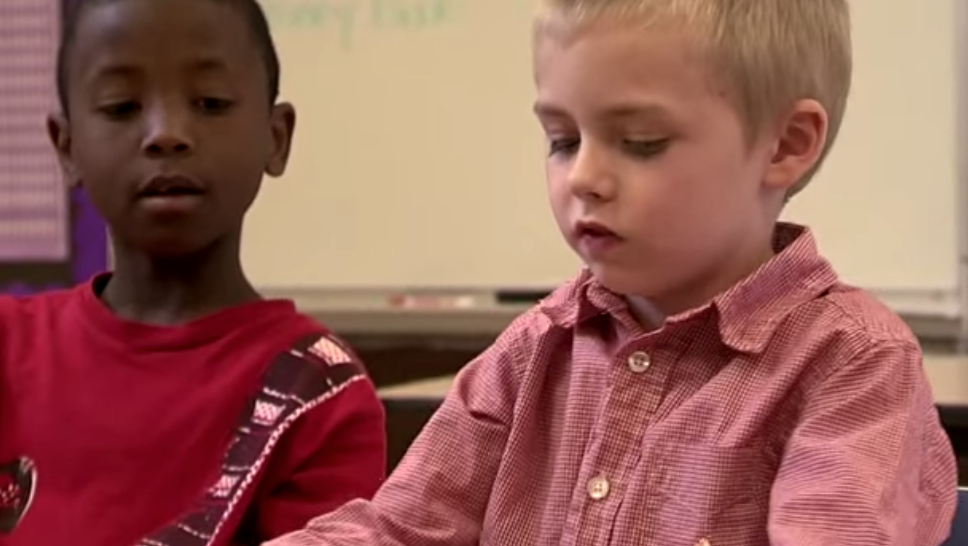
Play Tips for Peer helpers (Video)
Peer helpers support a child with autism playing a game.

Playworks
Playtime helps kids discover joy of being active. Research shows that active kids are stronger learners. By playing together, children practice how to get along. Kindergarteners with stronger social and…

Policy Statement: Supporting the Development of Young Children in American Indian and Alaska Native Communities Who Are Affected by Alcohol and Substance Exposure (PDF)
The purpose of this U.S. Department of Health and Human Services (HHS) policy statement is to support early childhood programs and tribal communities by providing recommendations that promote the early…
Policy Statement on Supporting the Development of Children Who are Dual Language Learners in Early Childhood Programs (PDF)
A major challenge facing early childhood education and the K–12 education system in the United States is the fact that as the population changes, the particular needs of children change…
Policy Statement on Early Childhood Career Pathways (PDF)
The Institute of Medicine (IOM) and National Research Council’s (NRC) 2015 report, Transforming the Workforce for Children Birth to Eight, offers recommendations for building a high quality early childhood workforce…
Policy Statement to Support the Alignment of Health and Early Learning Systems (PDF)
This statement provides policy and program recommendations from HHS and ED to improve young children’s access to needed services and transform delivery systems to improve health and early learning outcomes…
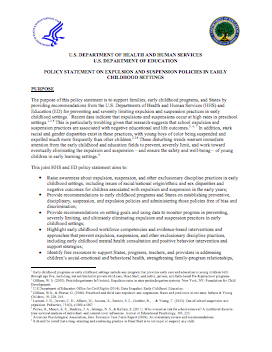
Policy Statement on Expulsion and Suspension Policies in Early Childhood Settings (PDF)
This Information Memorandum (IM) encourages Lead Agencies to adopt policies set forth in the Policy Statement on Expulsion and Suspension in Early Childhood Settings issued by the U.S. Departments of…
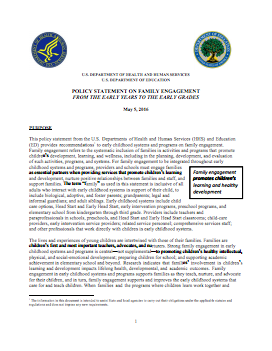
Policy Statement on Family Engagement (PDF)
When families and the institutions where children learn partner in meaningful ways, children have more positive attitudes toward school, stay in school longer, have better attendance, and experience more school…